
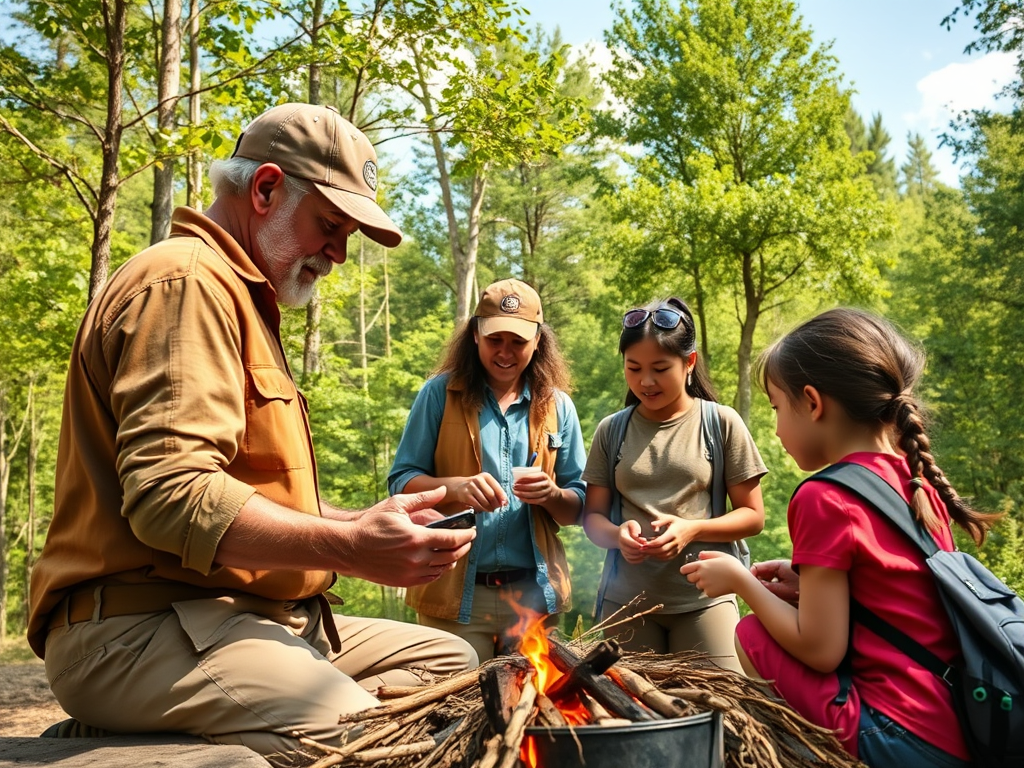
What we owe the person learning beside us
A person who asks you to teach them has handed you something more valuable than a paddle or a pocketknife. They have handed you a measure of trust. They expect you to know what you are doing, to notice when they are struggling, and to stop before enthusiasm carries the lesson somewhere it should not go.
That trust ought to make an instructor careful.
My outdoor life began with people willing to share what they knew. Scouting, paddling, camp cooking, and teaching have kept me in that company. During my three years as Handicraft Director at Camp Liberty, the work included overseeing staff and teaching young people in the arts and trades. On the water, the equipment and surroundings change. The obligation to the learner remains.
I want useful skills to survive. I also want the people learning them to come home with enough understanding to keep learning. A good afternoon is a beginning. It is not proof that someone is ready for every condition.
Reviewed and revised October 21, 2026. This essay concerns responsible teaching. It does not qualify readers to teach technical outdoor skills or issue certifications.
Know what you can honestly teach
Doing something well and helping another person learn it are related skills. They are not interchangeable. An instructor must also recognize errors, adapt an explanation, manage the group, and understand when conditions exceed the lesson.
The American Canoe Association’s instructor pathway separates paddling skills, technical knowledge, rescue ability, teaching ability, and group management. ACA instructors teach within their certification level using approved course outlines. That is a useful reminder that confidence and a collection of good trips are not an instructor qualification.
I am a Wilderness First Responder and a certified instructor qualified to teach Wilderness First Aid certification courses. Those are distinct credentials. Holding a responder certificate does not itself authorize someone to teach a certification course. Teach within your current qualifications, the course provider’s requirements, and the conditions you can responsibly manage.
There is dignity in saying, “That is beyond what I can teach you. Let us find the right person.” It saves a great deal of trouble later.
Prepare for the learner, not just the activity
Begin by asking what the person hopes to learn and what experience they bring. Discuss relevant access needs, concerns, and health considerations privately and respectfully. Age alone does not tell you how someone learns. Neither does the confidence with which they arrive.
Choose a specific, attainable objective. Explain the boundaries, necessary equipment, and how anyone can call a pause. Agree on a clear stop signal. Make it ordinary to ask for another demonstration or decline an activity without embarrassment.
For Scouting activities, Scouting America’s SAFE checklist addresses supervision, assessment, fitness and skill, and equipment and environment. Use the applicable program rules, required qualifications, supervision arrangements, and youth safeguarding requirements. A teaching method does not replace them.
Check the site, forecast, exits, communication, and emergency arrangements. Decide in advance what will cause you to move, simplify, postpone, or end the lesson. An instructor needs enough attention left over to watch people, not merely finish the demonstration.
Explain, demonstrate, guide, then enable
Scouting’s Teaching EDGE method offers a useful sequence: Explain, Demonstrate, Guide, Enable. The important part is the work between watching and doing independently.
Explain what the skill accomplishes and where it belongs. Demonstrate slowly enough for the learner to see the decisions as well as the movements. Guide practice with specific corrections. Reduce assistance when the learner shows readiness, while keeping the supervision the activity requires.
One demonstration may be enough to begin. It may take several more before the explanation makes sense. Repeating yourself with increasing volume is not a new teaching method.
Ask the learner to show the skill and explain a limitation. Can they recognize a poor setup? Can they tell you when they should stop or seek help? A successful attempt matters, but so does knowing when that success would not transfer.
A small lesson with room to think
Hypothetical teaching example: A learner is practicing a knot used in an ordinary tarp setup. Begin with short practice cords at a table, away from flames and people walking through camp. Explain that this is a camp task, not instruction for climbing, rescue, or any application supporting a person.
Show the knot, let the learner repeat it with guidance, and ask them to inspect the result. Then change one manageable detail. Can they tie it again and explain what it does? If frustration rises, pause and break the task into smaller steps.
The next step might be a supervised tarp exercise at a suitable site in benign weather. Site choice, anchor suitability, tree protection, and avoiding trip hazards now become part of the lesson. Speed is not the objective. A knot tied quickly does not make a poor campsite suitable.
Finish by asking what would change the plan. Damaged equipment, an unsuitable anchor, rising wind, or thunder should produce a decision, not a race to finish. The lesson succeeds when the learner can explain why the tarp might stay in its bag.
Leave room for mistakes, not preventable injury
A missed knot or an uneven pancake can be useful feedback. A learner cutting toward a hand needs an immediate stop. Do not wait for a dangerous action to finish so the lesson will be memorable.
Knife work requires suitable tools, stable working arrangements, instruction, spacing, and supervision appropriate to the person and activity. A named safety circle is only one consideration. Fire instruction needs current permission and suitable conditions. A fire stand does not override a restriction.
Medical simulations need equally deliberate boundaries. Explain that the incident is simulated, obtain consent for participation and contact, provide a way to stop, and avoid introducing real hazards for the sake of realism. Follow the provider’s approved curriculum and safety practices.
NOLS describes WFA as a practical introduction to wilderness medicine. A simulated injury is an opportunity to practice assessment, communication, and decisions within training. It does not establish a real diagnosis or confer a new scope of practice. The FloridaOATS first aid reading guide provides background for readers preparing to learn.
Teach care for the place while teaching the skill
The campsite is not disposable teaching material. Leave No Trace belongs in the choices made before the exercise: where to gather, what materials to bring, what to leave undisturbed, and how to manage waste.
Its workshop guidelines also distinguish outdoor ethics education from technical instruction in activities such as climbing or river crossings. Knowing how to discuss environmental impact does not establish competence to lead every activity used to illustrate it.
Bring practice materials rather than cutting living branches for convenience. Do not turn plant identification into an eating contest. Foraging instruction requires knowledge of the exact plant, part, preparation, permissions, and contamination risks. Feeling certain is not a substitute for those checks. Our corrected articles on Florida foraging and shelter decisions explain the limits.
Let the learner speak before you give the verdict
After practice, ask what worked, what remained uncertain, and what they would do differently. Listen before delivering your own account. Give feedback about an observable action and a useful next step.
Invite questions about your decisions too. A beginner who asks why you chose a landing or cancelled an exercise is participating responsibly. The experienced person should be able to explain the reasoning, or admit that it needs another look.
End with an honest account of readiness: what the learner demonstrated, under which conditions, what still needs supervision, and where to find further instruction. Encouragement is useful when it points toward the next piece of work.
The work worth passing on
Food is as important as the love of family gathered around the campfire. Teaching belongs at that gathering too: preparing the meal together, caring for the equipment, making room for a question, and leaving a decent place for the people who follow.
I want someone to inherit more than the motions of a skill. I want them to inherit the care that makes it worth knowing. The old ways deserve that much from us.
Here at FloridaOATS, I explore why these skills matter. At Liquid Rhythm Kayaking, readers can find the practical instruction behind that discussion. Visit current kayaking classes and lesson information for help choosing suitable training, or ask about an appropriate next step. An article can start the conversation. Learning requires practice, feedback, and time.
Jeffrey John Fabiszewski
FloridaOATS
Documentation and further reading
Primary sources checked October 21, 2026. The teaching recommendations in this essay are my synthesis, not a certification curriculum or a claim of endorsement by these organizations. Follow the current requirements of the organization and activity involved.
Scouting America: The Teaching EDGE Method
Scouting America: SAFE Checklist
American Canoe Association: Become an Instructor
NOLS: Wilderness First Aid
Leave No Trace: The Seven Principles
Leave No Trace: Workshop Guidelines
Wilderness First Aid teaching: Jeff Fabiszewski teaches Wilderness First Aid as a member of the Greater Tampa Bay Area Council Wilderness First Aid teaching team. Billy McCracken serves as Course Director. Jeff’s WFA teaching role is distinct from his Wilderness First Responder qualification and does not establish authorization to teach or certify WFR courses. Jeff and Billy are developing Wilderness First Aid for Kayakers as a proposed program, with a goal of launching within the next year. Enrollment is not open and no launch date is confirmed. The proposal is separate from existing council courses; council sponsorship or approval is not claimed. See the official council WFA event listing for that event’s registration and requirements.


Leave a Reply