
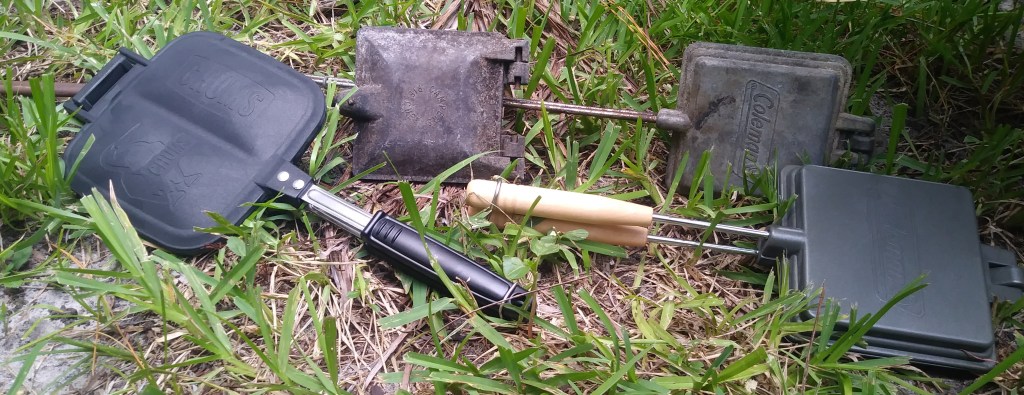
A crisp edge, a familiar meal, and an old Scouting pleasure seen through a different camp kitchen.
I grew up in Scouting around campfires, laughing and enjoying hot pressed sandwiches and crispy fruit filled pies made in long handled pie irons. I still yearn for that tasty goodness.
The appeal was never difficult to explain. Bread went into the iron, something good went between the slices, and the fire did its part. There was anticipation in opening the cooker. Supper had a small ceremony of its own.
Years later, photographs from Japanese campers caught my attention. Their sandwich cookers had short handles and compact bodies. The tool looked different, but I recognized the promise: a hot sandwich with a crisp edge, made outdoors.
An old pleasure in another form
I had been thinking about the limitations of the long handled tools I knew. A large wood fire is not always permitted or appropriate, and a cooking arrangement that suits one campsite may be awkward at another. I wanted to explore a different way of making food I already enjoyed.
The Japanese camping photographs offered possibilities. I could admire another camper’s meal without pretending that a photograph told me everything about the equipment or its safe use. What interested me first was the food and the care given to preparing it.
That is often how an old practice remains useful. We recognize something familiar in a different form, try to understand it, and decide what belongs in our own lives. Tradition does not require every handle to remain the same length.
The package from Japan
On Saturday, August 14, 2021, I ordered two sandwich cookers from Amazon Japan. The package arrived four days later. One was a Coleman 170-9435 Hot Sandwich Cooker. The other was a CHUMS CH62-1180 Double Hot Sandwich Cooker.
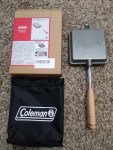
My first notes described the Coleman as compact, with a smooth, light colored interior and a lantern emblem that would mark the bread. The CHUMS packaging reminded me of American advertising from the 1950s. Its cooker carried the brand’s booby bird design. Even before cooking, I was looking at the relationship between a useful object and the pleasure of using it.
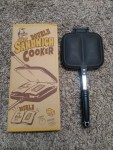
Those were first impressions, not the results of years of use. The original article wondered how the handles would last and exaggerated how much punishment the CHUMS might withstand. Appearance did not establish durability. I would rather preserve the excitement of opening the package than turn it into evidence I never collected.
My proposed test menu included pressed Cuban sandwiches, Italian panini, fried queso, quesadillas, and pizza. That list records what I hoped to try. It is not a claim that every experiment was completed or successful.
The meal matters more than the collection
A new cooking tool can make a convincing case for itself before it has produced lunch. I am susceptible to that argument. My original article even included three more cookers I wanted to acquire. Apparently two arriving in one package had not exhausted the possibilities.
Still, the useful question is what a tool lets us do for the people we feed. A sandwich cooker earns its place through meals, care, and repeated use. Its country of purchase and the logo pressed into the crust are interesting details. They do not feed anyone by themselves.
The pleasure I remember from Scouting belongs to the whole occasion: the food, the laughter, and the people gathered near the fire. A compact cooker may help bring something of that pleasure to another setting. We still have to make time for the people.
Keeping the pleasure, changing the method
I value outdoor cooking traditions because they give us something worth continuing. That includes accepting the limits of a place. When a wood fire is prohibited or conditions make cooking unsafe, nostalgia does not grant an exception. Choose a permitted, suitable arrangement or change the meal.
Nor does a short handle establish that a cooker is suitable for every burner. Follow the instructions for the exact cooker and stove, including compatibility and heat restrictions. My purchase account is not approval for a particular combination.
There is plenty of room for invention within those limits. The goal is a meal people can enjoy together, prepared with attention to the place and to one another.
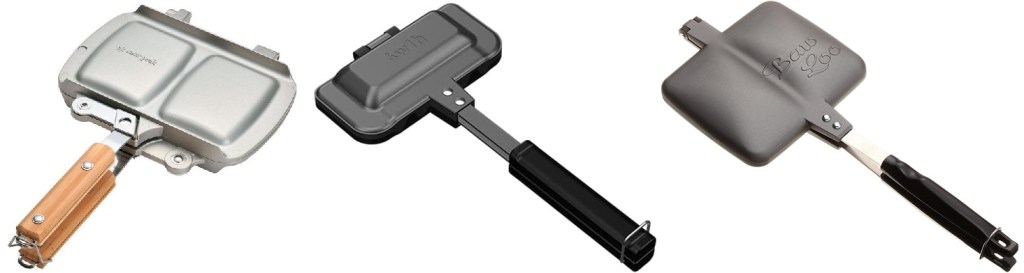
That is what brought these cookers into my Florida camp kitchen. I saw another way to carry forward something I had loved as a Scout. The handle was shorter. The invitation remained familiar: there is something hot to eat, and room to stay awhile.
Jeffrey John Fabiszewski
My Yoshikawa SJ1681: more than a sandwich cooker
I own the Yoshikawa SJ1681, matching the model linked here. I think of it as a double skillet, and I choose it when I am cooking one serving. When I want a double serving, I reach for my CHUMS cooker. That is how I use the two tools, rather than a fixed promise about every meal’s capacity.
My meals include Cinnamon Apple and Raisin Pockets; pressed kielbasa, sauerkraut, and mustard on rye; fish with lemon, garlic, and oregano; fish tacos; Japanese Gyoza Pockets; Florida Cuban Fish Melts; S’mores Pockets; campfire gnocchi with pesto and sundried tomatoes; shrimp; and Reubens. The cooker’s usefulness goes beyond bread, though the portion and thickness still need to suit the pan.
Cleanup has been easy in my use. Cheese has not stuck to the surface so far, and I use a cotton cloth to wipe away residue while the cooker is warm enough to handle safely. That describes residue removal, not a substitute for proper washing after raw seafood or other contamination. Follow the manufacturer’s care instructions.
On mine, I observe a gap of about one to two millimeters where the halves close. Steam can escape there, and grease can too. In my gas stove setup, grease does not drip onto the stove. With wood or charcoal cooking it can drip onto the coals, and flipping the Yoshikawa too quickly can let grease escape. Turn it deliberately and account for hot fat when choosing the cooking position.
What makes an outing memorable to me is the people I am feeding or the place where I am cooking. Food supplies the energy for the journey. If it tastes good too, that is an extra bonus.
How I watch fish and shrimp cook
For fish, I watch the change from translucent flesh toward opacity at the cut edge and toward the center. I also look for separation along the natural muscle lines when checked gently with a fork, and for a firmer, springy texture rather than soft flesh or a dry, stiff result. With salmon, I notice the white albumin appearing at the surface as cooking progresses. These are cooking observations, not precise measures of internal temperature; albumin alone does not establish either safety or overcooking.
For shrimp, I watch the change from a loose curve toward a C shape, with a tight O and rubbery, dry flesh suggesting that I have taken it too far. “C is cooked, O is overdone” is a kitchen memory aid, not proof that a shrimp is safe to eat. Shape alone should not determine when to stop cooking.
Food safety check: Use a food thermometer to check fish at its thickest part for 145°F (63°C). FDA guidance describes cooked shrimp flesh as firm, pearly, and opaque. A browned sandwich exterior does not establish that a raw filling is cooked through; follow guidance for the actual filling. See the FDA safe food handling guidance and seafood cooking guidance.
Paid link notice: As an Amazon Associate I earn from qualifying purchases. View the Yoshikawa SJ1681 Hot Sand Maker on Amazon (paid link).
My CHUMS double cooker: what I actually use it for
I own the CHUMS CH62 1180 Double Hot Sandwich Cooker, matching the linked model. I choose it when I want two servings. That is its advantage over the Yoshikawa SJ1681 in my own cooking; I am not claiming that it cooks better.
My CHUMS meals include Granny Smith Cheddar and Thyme Toasties, S’mores Pockets, shishito pepper poppers, cinnamon rolls, tsuna mayo corn cheese, Spam with egg and cheese, okonomiyaki sando, and a miso butter yaki onigiri press. These are meals I have actually made, separate from the proposed test menu in the original account.
Inside mine, a raised center divider separates the sections, and each section has a raised CHUMS mascot design. When the two halves close like a clamshell, I do not observe the gap that I see on my Yoshikawa. This describes the fit of my cooker; it does not establish that it is a sealed or leakproof container.
Nothing about the CHUMS has bothered me in my use. My choice starts with what I am cooking: if I need a smooth interior surface, I leave this one at home and take the Yoshikawa SJ1681. If I want a double serving and the raised interior suits the meal, I choose the CHUMS.
Paid link notice: As an Amazon Associate I earn from qualifying purchases. View the CHUMS CH62 1180 Double Hot Sandwich Cooker on Amazon (paid link). Check the selected model and seller before buying.
Related reading and product reference
For another FloridaOATS reflection on familiar camp food, read A Reuben in Camp: Familiar Food, Farther from Home. For the broader camp kitchen discussion, see Camping Stove Tricks: The Burner Pad and the Better Supper.
The CHUMS manufacturer page documents the double sandwich cooker named in the original purchase account. Product versions and instructions may change. The purchases, first impressions, and wish list above describe August 2021, rather than current shopping recommendations.


Leave a Reply