
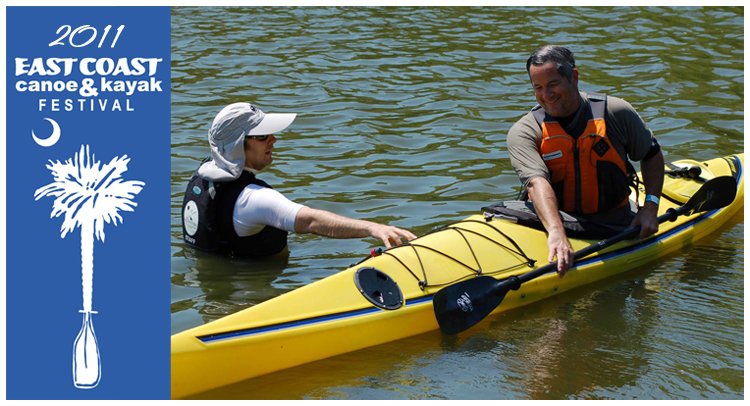
A photograph made at a kayak festival in Charleston in 2010 became an advertisement in 2011. Years later, it has become something else: a reminder that outdoor knowledge survives when people teach it.
A weekend in Charleston
In April 2010 I traveled to James Island County Park near Charleston, South Carolina, for the twentieth annual East Coast Canoe and Kayak Festival. The festival ran April 16 through 18. I was there as a guest instructor with H2Outfitters, working with Jeff Cooper and Cathy Piffath. In one photograph I am in the water teaching kayaking. Nothing about it announces itself as history. It is an instructor and a paddler, a boat, and a lesson underway.
The photograph came back the following year in promotional material for the 2011 festival. That is why the image carries a 2011 graphic even though the teaching happened in 2010. I have learned to appreciate these small distinctions. Memory supplies the story, but dates and artifacts keep us from rearranging it to suit ourselves.
The old way of learning
For most of human history, practical knowledge moved from one pair of hands to another. Someone showed you how to hold a tool, read a current, repair a boat, prepare food, or recognize when the weather had changed its mind. A book could help. So could a drawing. But eventually you had to do the thing yourself, often with somebody close enough to notice what you were doing wrong.
Kayak rolling is like that. A description can tell you where to put the paddle. A video can show you what the movement looks like. Neither can give you the sensation of a hull beginning to return beneath your hips, or teach you how to remain composed when the world turns upside down. That knowledge must find its way into the body.
What the Greenland qajaq remembers
The traditional Greenland qajaq was a working hunting craft, not simply recreational equipment. Its many recovery techniques preserve answers to difficult questions. What if a hunter lost a paddle? What if a hand was occupied, injured, or caught in a line? What if a hunting animal pulled the boat over? What if cold water made a prolonged struggle dangerous?
We should not pretend that every named roll has a single proven origin. Nor should we reduce Inuit culture to a romantic tale of lonely men battling the ice. Hunting was embedded in families, communities, knowledge, and responsibility. A hunter’s ability to return safely and provide food mattered to people waiting ashore. The craft was part of a larger way of life.
That is why I have always been drawn to Greenland paddling. The skill is beautiful, certainly. There is room for sport, competition, and the satisfaction of doing a difficult thing well. But the beauty did not erase the practical problem the technique was meant to solve. Qajaq USA is one place where this living tradition continues to be studied and shared.
Twelve kayaks and one chair
During that same April 2010 festival I took a class with Derek Hutchinson. Twelve of us were on the lake in kayaks. Derek taught from a chair on the bank.
It sounds almost comically simple until I consider what he accomplished from that chair. He watched closely and used specific words to guide what we noticed and tried. Rather than relying on a continuous demonstration, he created space for us to discover how a movement worked in our own boats.
That lesson has remained with me. Outdoor knowledge does not pass from teacher to student merely because an expert performs a beautiful maneuver. It passes when the teacher can see what the learner needs, find the words that matter, and allow the learner to do the work. The chair on the bank taught me as much about instruction as the movements we practiced on the water.
The lesson nobody notices
At the Charleston festival I remember speaking with Derek Hutchinson. I cannot give you his exact words after all these years, but the idea I carried away was that a perfect roll may follow a brace that failed to keep the paddler upright.
That observation made sense to me. I had written about the superiority of a successful brace in my Liquid Rhythm journal in 2009, before that weekend. The conversation was not the birth of the idea. It was one of those moments when another instructor helps you recognize something experience has already been teaching.
A roll is dramatic. A brace that prevents a capsize can be nearly invisible. I have noticed the same thing in wilderness education. We remember the rescue, the emergency treatment, and the difficult return to camp. We seldom celebrate the quiet decision that prevented the emergency: an earlier departure, a safer route, a weather check, or a warm meal before somebody became exhausted.
Experience has taught me to admire the things that did not happen.
Sunday supper and the rhythm of the water
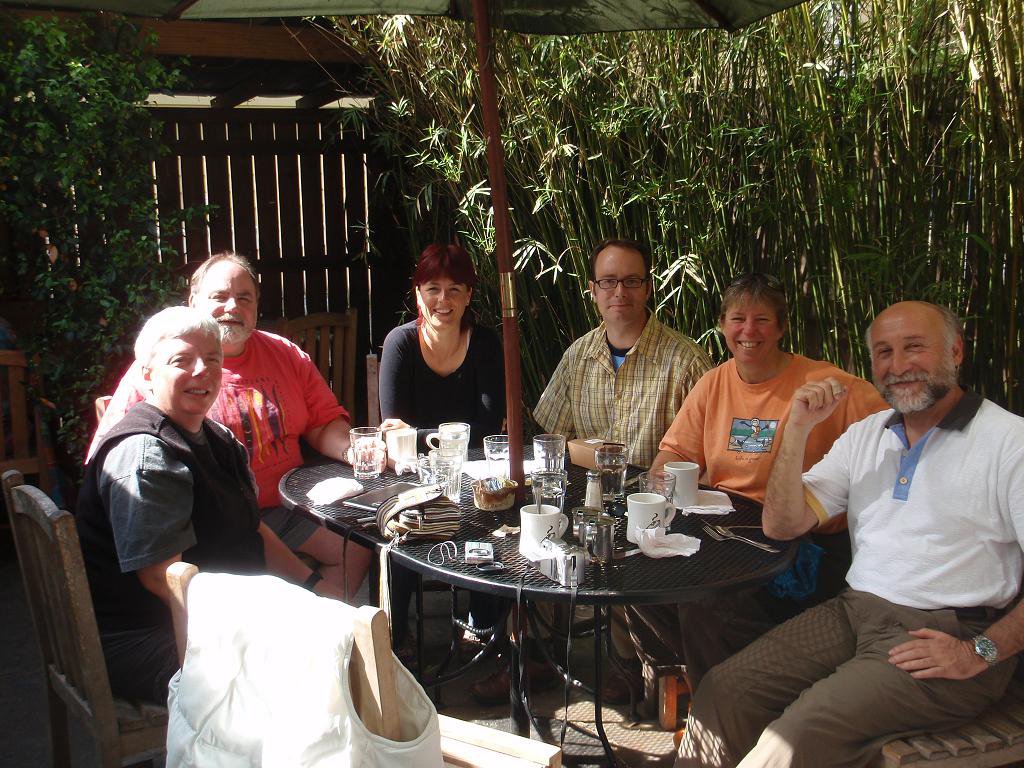
When the festival ended on Sunday, the conversation continued around a dinner table. I remember sharing that evening with Cathy Piffath, Jeff Cooper, Jon Engel, and Ward Swann. Ward was behind the camera, which is why he does not appear in the photograph. Six people are visible around the table, and I will leave the identification of the others to a better record rather than guess.
Somebody raised the old question of Greenland rolling. We laughed about the notion that Greenland kayakers spent more time rolling than paddling, and that a little more practice with bracing might have saved them from needing so many recoveries. It was the sort of joke paddlers can make over dinner after spending a weekend talking seriously about boats. It was not a verdict on Inuit seamanship. The traditional qajaq and its recovery techniques belonged to a world where the consequences of capsize could be severe.
What I remember most is that the lessons did not end when the boats came ashore. Around a table, over food, people who loved the same craft could challenge each other, laugh, and keep learning. That is how a living tradition travels.
Kayaking has never been only paddling or only rolling. It is going with the flow. Sometimes the water carries us somewhere unexpected. Sometimes we make a clean maneuver and briefly imagine we have mastered it. But we are dancing on the water, following a rhythm that sometimes skips a beat. There is wisdom in remembering that the water leads as often as we do.
What a photograph can carry
I look at this picture now and see more than a younger instructor at a paddling festival. I see a small part of a much older exchange. One person has learned a craft and is trying to pass it along. The student will eventually have to make the movement alone. If the lesson holds, perhaps that student will one day teach somebody else.
There is a limit to what an archive can do. A photograph cannot give a person balance. A book cannot replace a day on the water. But a surviving image, correctly dated and honestly described, can preserve the names, places, and ideas that might otherwise disappear.
The photograph was used to invite paddlers to the 2011 festival. Today I hope it offers a different invitation: learn from somebody who has done the work, practice until the knowledge becomes your own, and then pass it along.
Not every important lesson ends with applause. Some end with everybody still upright, paddling home, and supper waiting.
For the technical discussion of bracing, rolling, and my teaching approach, read “Every Roll Begins With a Failed Brace” at Liquid Rhythm Kayaking.


Leave a Reply