
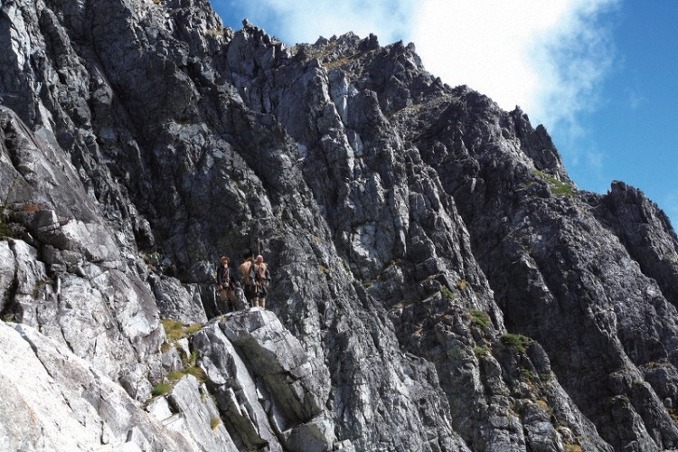

The Summit: A Chronicle of Stones to Serenity (2009) is a beautiful film. Snow covered mountains rise above a sea of clouds, and the scenery alone would have held my attention. But I keep returning to it because the reasons for exploring matter as much as reaching the summit.
I was captivated by the equipment, too. Of course I was. Put a camp stove in a historical film and I will probably spend part of the evening examining the stove.
What stays with me, though, is the judgment taking place around that equipment. Who looks prepared? Who appears to belong? Whose knowledge counts when the mountain stops cooperating?
A mountain, a map, and several reasons to climb
Directed by Daisaku Kimura and based on a novel by Jiro Nitta, the film dramatizes a survey expedition to Mount Tsurugidake in Japan in 1907. Army surveyor Yoshitaro Shibazaki works with local guide Chojiro Uji and his companions while members of the Japanese Alpine Club pursue their own ascent. The Japanese Film Database entry provides the production details and story outline. This is a historical drama, rather than a documentary record of the expedition.
The Army has an assignment to complete. Its authority and reputation bear upon the work. The club members bring the ambitions and equipment of recreational mountaineering. The local guide brings knowledge formed through a life spent among these mountains. In my reading of the film, those different relationships with the same landscape are its real subject.
An empty place on an official map is not necessarily an unknown place. The surveyor may need measurements that nobody has recorded in the required form. The person guiding him may already know the approach, the weather, and the cost of a poor decision. Both kinds of knowledge matter. Trouble begins when one is mistaken for the whole.

What the equipment tells us
The contrast between traditional supplies and the Alpine Club’s more modern equipment caught my eye. Heavy loads, familiar tools, unfamiliar designs, and the labor of carrying everything make the material side of exploration hard to ignore. There is history in the gear, but there is also social standing.
We still read people through their possessions. A new pack can look like competence. A faded jacket can look like neglect. Sometimes those impressions tell us something useful. Often they tell us more about our own expectations.
An old piece of equipment deserves inspection, not automatic admiration. A new one deserves practice, not automatic trust. Condition, suitability, and the user’s ability to operate it matter more than its age. A worn tool may have years of service left. It may also be worn out. Affection does not repair a failed seam.
As an outdoor educator, I find that a useful discomfort. Before I decide what another person knows, I ought to listen to what that person notices.
The stove I may have misidentified
In an exchange between the survey party and the club members, I thought I recognized a Svea 123 stove. Its appearance made me wonder whether a much later model had found its way into a story set in 1907.
That remains a suspicion. I have not verified the prop’s identity or established a production error. My earlier wording gave that conclusion more certainty than it deserved. The manufacturer’s current Svea page is a reference for the present product, not proof of what appears on screen or when that particular design first appeared.
The question still interests me. Historical equipment helps us imagine how people worked, cooked, traveled, and endured discomfort. Getting it right matters. So does admitting when an attentive viewer may simply be wrong.

Studying a place and living within it
I recognize the distinction between studying a landscape and living and traveling within it. My studies in history, American studies, and cultural anthropology have taught me to value records and careful interpretation. My work on the water has taught me to pay attention when someone knows a place in ways a written account cannot easily hold.
That does not make local knowledge infallible. Familiarity can encourage complacency, just as formal training can encourage misplaced confidence. The strongest party has room for measurements, experience, questions, and disagreement. Someone must be willing to say that the conditions have changed. Someone else must be willing to hear it.
The guide interests me because the mountains are part of his ordinary world. What looks like an expedition destination to a visitor can be home, livelihood, memory, and obligation to someone else. That difference should change how a traveler arrives.
What I bring back from the film
There is pleasure in watching capable people do difficult work with tools from another age. There is also a warning against confusing the appearance of authority with the substance of judgment. A uniform establishes a role. A club establishes an association. Equipment establishes what someone brought. None of them settles whether a person will make the right decision.
That is why this film belongs among my FloridaOATS reflections. The attraction is more than distant mountains or old camping gear. It asks why we go, what we hope to prove, and whether we can recognize knowledge when it arrives without the costume we expected.
I still enjoy the scenery. I still watch the equipment. But the question that follows me away from the screen is simpler: am I listening to the person who knows this place, or merely admiring the person who looks the part?
Jeffrey John Fabiszewski
Companion reading: My earlier Liquid Rhythm review records my initial response to the film. It retains the older stove identification, which should be read with the uncertainty explained here.


Leave a Reply